For law firms, reputation is not a side issue. It is part of the marketing engine.
When someone is searching for legal help, especially after an accident or injury, they are looking for trust signals fast. They want to know whether a firm is credible, responsive, experienced, and capable of getting results. Online reviews play a huge role in shaping that first impression.
This case highlights how one multi-location personal injury law firm improved its social proof, streamlined feedback collection, and made better use of client reviews across its marketing.
The challenge: reputation management was taking too much manual effort
Before improving its system, the firm had already experimented with reputation management tools. Like many growing businesses, they knew reviews mattered, but managing them consistently was difficult.
The real issue was not awareness. It was execution.
They needed a process that could do more than simply request reviews. It had to fit into their existing workflow, reduce manual follow-up, support multiple office locations, and help the team stay organized as feedback came in.
For a busy law firm, reputation management could not be one more disconnected task. It had to become part of the way the business already operated.
The goal: create a review strategy that actually works at scale
Instead of treating reviews as an occasional marketing task, the firm needed a systemized approach.
That meant creating a process that could:
- trigger review requests automatically
- segment communications based on client type
- support both first-party and third-party feedback
- help the team track and respond to reviews efficiently
- surface reviews across the website in a way that builds trust
In other words, the goal was not just to collect more reviews. It was to build a stronger, more visible reputation across every stage of the client journey.
Bilingual review experiences mattered
A major factor in this firm’s strategy was language.
A large portion of their client base was Hispanic, and they already served both English-speaking and Spanish-speaking audiences online. That meant their review experience also needed to reflect that reality.
Rather than mixing all feedback together, they benefited from organizing reviews by language so that website visitors could see testimonials that matched the language of the page they were viewing.
This matters more than many businesses realize.
When someone lands on a Spanish-language service page and immediately sees reviews written in Spanish, the experience feels more relevant, more trustworthy, and more personal. It reduces friction and reinforces that the firm truly serves that audience, rather than simply translating a few pages.
Language-based review filtering also improves outreach. When feedback requests are sent in the client’s preferred language, response rates tend to improve because the process feels easier and more natural.
Integrations helped remove friction from the process
One of the biggest wins came from connecting reputation management to the tools the firm was already using.
Instead of relying on staff to remember when to send review requests, they tied the process to internal workflows. Once a case reached a certain stage, feedback outreach could be triggered automatically.
This reduced delays, improved consistency, and made the process more dependable.
The firm also used segmentation to create multiple client profiles, allowing communications to be customized based on case type or workflow status. That level of organization matters because not every client relationship looks the same, and not every follow-up message should sound the same.
When review generation is connected to your CRM or case management flow, it stops being random. It becomes operational.
Automation increased review volume on key platforms
Once the feedback request process became more consistent, the firm saw stronger review activity on major public-facing platforms such as Google and Facebook.
That kind of visibility is powerful for a law firm.
Detailed third-party reviews do more than improve star ratings. They give potential clients evidence. They show real experiences, real outcomes, and real human interactions. In many cases, those reviews mentioned staff members, case managers, and specific aspects of service that made clients feel supported.
That kind of specificity is gold.
It helps future clients picture what it is like to work with the firm, and it also gives internal teams insight into what clients value most.
The result is stronger social proof, stronger local visibility, and better feedback for internal improvement.
Reviews became part of the website experience, not just a Google asset
Too many businesses collect reviews and leave them sitting on third-party platforms.
This firm took a smarter route by putting reviews to work on its own website.
Testimonials and review widgets were displayed across key sections of the site, including major landing pages, service pages, and location-specific pages. This allowed potential clients to encounter trust signals at the exact moment they were evaluating whether to contact the firm.
That is a major shift.
Instead of expecting someone to leave the site and go research reputation elsewhere, the business brought social proof directly into its digital journey. Reviews were no longer passive. They became part of conversion strategy.
For multi-location firms, this gets even better when each office page highlights reviews specific to that location. That gives each office a more localized and relevant presence.
Faster response management improved the firm’s online presence
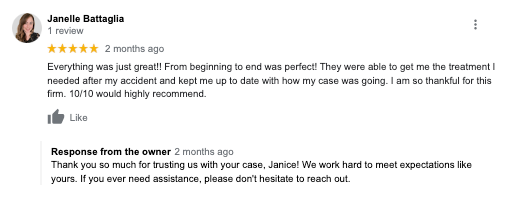
Collecting reviews is only half the equation. Responding to them matters too.
With better filtering, alerts, and dashboard visibility, the firm was able to keep up with incoming feedback more consistently. New review notifications made it easier to acknowledge positive comments quickly and address concerns before they lingered.
This is important because consumers increasingly expect businesses to respond. A review with no response can feel ignored. A thoughtful response shows attentiveness, professionalism, and accountability.
For legal brands in particular, responsiveness supports credibility. It signals that the firm is engaged, organized, and client-aware.
Location-level reporting created better operational insight
Because the firm operated across multiple offices, it was important to understand performance at the location level.
Custom fields and reporting made it easier to compare metrics such as:
- review request activity
- open rates
- number of reviews received
- review growth by location
- trends in client satisfaction
This gave the team more than a marketing snapshot. It gave them operational visibility.
Instead of seeing reputation as one broad brand-level metric, they could identify what was working well in one office and what needed attention in another. That kind of clarity helps leadership make smarter decisions.
Review insights revealed what clients cared about most
Beyond volume, the content of reviews provided valuable patterns.
Sentiment analysis and visual reporting helped the team identify which words, names, and service elements showed up most often in positive feedback. Mentions of team members, communication, case support, and service quality helped reveal what clients appreciated most.
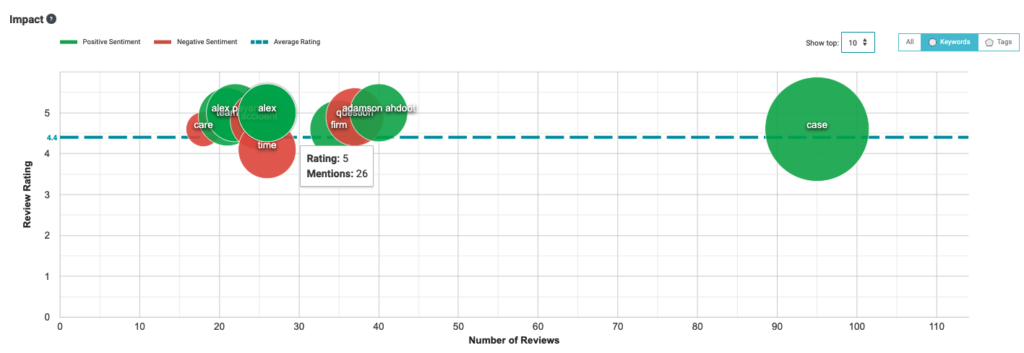
This kind of insight can be useful far beyond reputation management.
It can influence:
- marketing messaging
- hiring and training priorities
- staff recognition
- service improvements
- positioning on landing pages and ad campaigns
When businesses actually study their reviews, they often uncover their strongest differentiators in the words of their own customers.
Strong support and onboarding accelerated results
Another factor in the firm’s success was proper implementation.
A good reputation system only works if the team understands how to use it. With the right onboarding, training, and responsiveness from the platform team, the firm was able to get more value from the tools and tailor the setup to fit its workflow.
That matters because reputation management is not just software. It is process design.
The businesses that see the best results are usually the ones that align the platform with how they actually operate.
The bigger takeaway for law firms
This example shows something important: reviews are not just about stars.
When handled strategically, reputation management can help a law firm:
- increase review volume
- improve trust with prospective clients
- support bilingual audiences more effectively
- automate feedback collection
- highlight social proof across the website
- monitor performance by office or team
- learn what clients value most
For law firms competing in local markets, that combination is incredibly valuable.
A stronger review strategy does not just help you look better online. It helps you market more effectively, identify service strengths, and create a better client experience from first impression to final follow-up.
Final thoughts
Social proof is one of the most persuasive assets a law firm can build, but only if it is actively managed.
The firms that win are usually not the ones with the biggest ad budgets alone. They are the ones that make trust visible. They make it easy for happy clients to leave feedback, easy for prospects to see proof, and easy for internal teams to turn that feedback into action.
That is what a mature reputation strategy looks like.
And for firms that want to stand out in crowded local markets, it is becoming less optional by the day.
Want help building a stronger review strategy for your business?
If your business is getting great feedback but not turning it into visible social proof, that gap is costing you.
We help local businesses create smarter reputation systems that generate reviews, strengthen trust, and improve how they show up across Google and beyond.

Download Visibility Scorecard
If you want a clear, low-stress way to see where your visibility is strong and where it’s creating friction.
Here’s a simple system:
- Ask at the right moment — right after they’re satisfied, not weeks later.
- Invite specific feedback — ask about their real experience, not generic praise.
- Respond to every review — show future customers that you listen.
- Let reviews be honest — a mix of four and five-star reviews is more credible than perfect ratings.
Clarity builds trust faster than perfection ever will. When your reviews feel real, buyers feel safe choosing you.
To see how your current reviews are actually landing with potential customers, Download Visibility Scorecard here.