You can have plenty of visibility and still feel invisible where it counts.
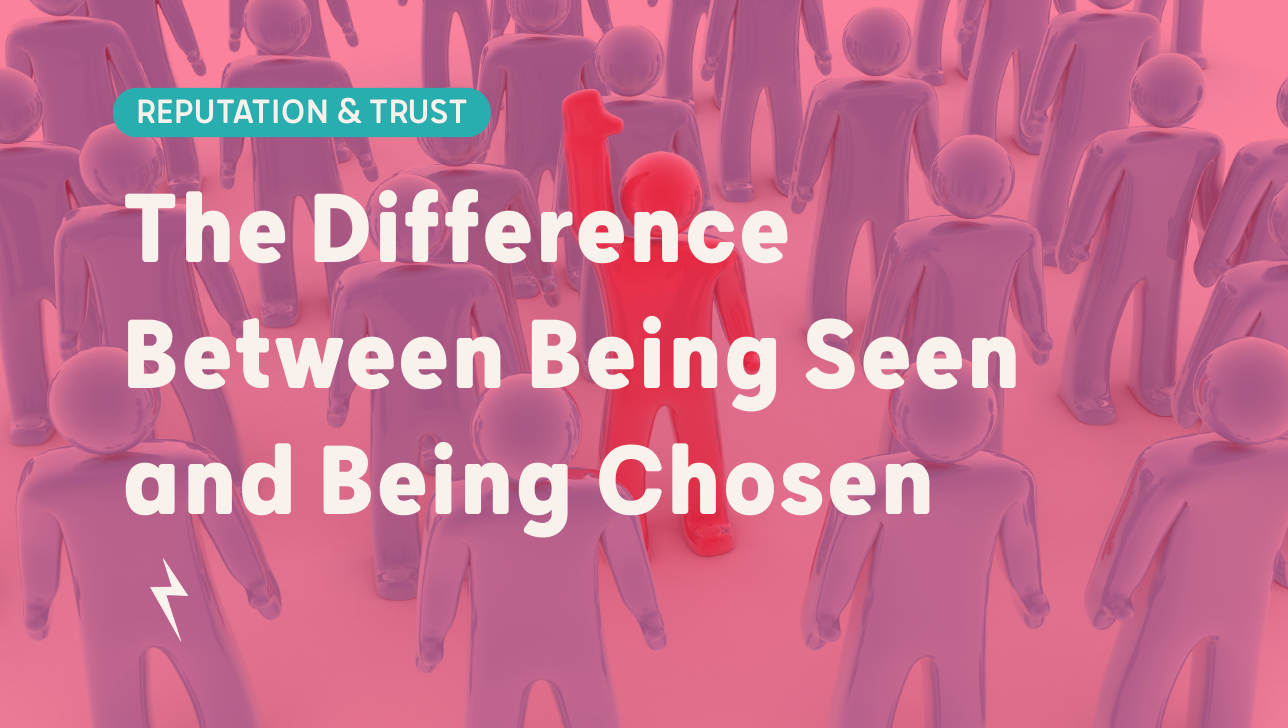
You get traffic. You get clicks. You get impressions. But you don’t get conversions. And that gap—between being seen and being chosen—is where most business owners get stuck.
The problem isn’t that people don’t know you exist. It’s that they don’t feel safe choosing you.
What’s actually happening beneath the surface
Visibility and conversion are two different problems that require two different solutions.
Visibility is getting in front of the right person. That’s what ads, content, and SEO do. Conversion is being the option they choose. That’s what credibility does.
A home services company can run ads and get hundreds of clicks. But if their website looks outdated, reviews are missing, and it’s unclear what they guarantee, most people leave. They were seen. They weren’t chosen.
Why? Because being seen creates the opportunity. Being chosen requires proof that it’s safe.
Buyers move through two stages. First, they need to find you (visibility). Second, they need to believe you won’t let them down (credibility). Most marketing effort focuses on stage one. Most conversion problems happen in stage two.
Reframing the problem (so you know what to actually fix)
If you’re getting visibility but not conversions, you don’t have a visibility problem.
You have a credibility problem.
And that changes everything about what you do next.
More ads won’t fix it. Better keywords won’t fix it. More social media content won’t fix it. What fixes it is making the invisible visible—proof, consistency, clarity, testimonials, recent work examples, professional presence.
A local contractor was spending money on ads and getting decent traffic. But his conversion rate was half the industry average. His first instinct was to hire a copywriter to rewrite his website.
He was wrong about the problem.
When we looked at what actually happened after someone clicked his ad, the issue was clear: his website had no recent photos, one generic testimonial from 2019, and no clear explanation of his warranty or process. New clients couldn’t reduce their risk because there was no proof to anchor it on.
He didn’t need better words. He needed better proof.
Book a Demo Call if you want clarity on whether you’re stuck at visibility or conversion, and what actually fixes it.

Book a Demo Call
If you want a clear, no-pressure conversation about where to start and what your next step actually is.
How this connects to long-term strategy
The businesses that feel effortless to grow are the ones that understand this distinction.
They invest heavily in being seen through ads, content, and visibility. But they invest even more in making sure what people find feels solid and trustworthy.
When credibility is strong, marketing becomes efficient. Fewer people need to see you because more of the people who do see you actually convert. Your ads get cheaper. Your word-of-mouth speeds up. Your reviews compound.
But when credibility is weak, you need constant visibility effort to offset low conversion rates. You’re always pushing more traffic at a broken funnel.
The practical starting point
Ask yourself: When someone finds me and decides not to choose me, why?
Is it because they didn’t understand what you do? That’s a clarity problem. Fix your message.
Is it because you look inactive or unprofessional? That’s a consistency problem. Fix your online presence.
Is it because there’s no proof you deliver? That’s a credibility problem. Collect testimonials, photos, reviews, guarantees.
Each answer tells you where to focus first.
You don’t need to fix everything at once. You need to know which layer is broken—visibility, clarity, or credibility. Then you fix that layer before you add more traffic on top of it.
Book a Demo Call to see where your real conversion block is and what actually needs to shift.
Book a Demo Call
If you want a clear, no-pressure conversation about where to start and what your next step actually is.
The frustration of getting traffic but not conversions isn’t a reflection on your business. It’s usually just a signal that your proof layer needs attention.
When people see you and feel safe choosing you, marketing stops feeling like work.